
Across the UK, universities are facing a data dilemma – more information than ever, but less clarity on what to do with it. With student expectations rising, budgets tightening, and hybrid learning here to stay, institutions are realising that data alone isn’t enough.. it’s what you do with it that drives change.
Today’s universities generate enormous volumes of data, from student records and virtual learning environments to research outputs and HR systems. The challenge lies not in collecting this data, but in making sense of it. When managed and analysed effectively, data can inform academic strategy, improve student outcomes, and drive operational efficiency across the institution.
From Data to Action : Building the Foundations
Before any AI or analytics initiative can succeed, universities must establish the right data foundations. This means identifying data silos, ensuring interoperability between systems, and creating clear governance structures.
Universities sit on a wealth of data, but most of it remains underused because systems don’t talk to each other
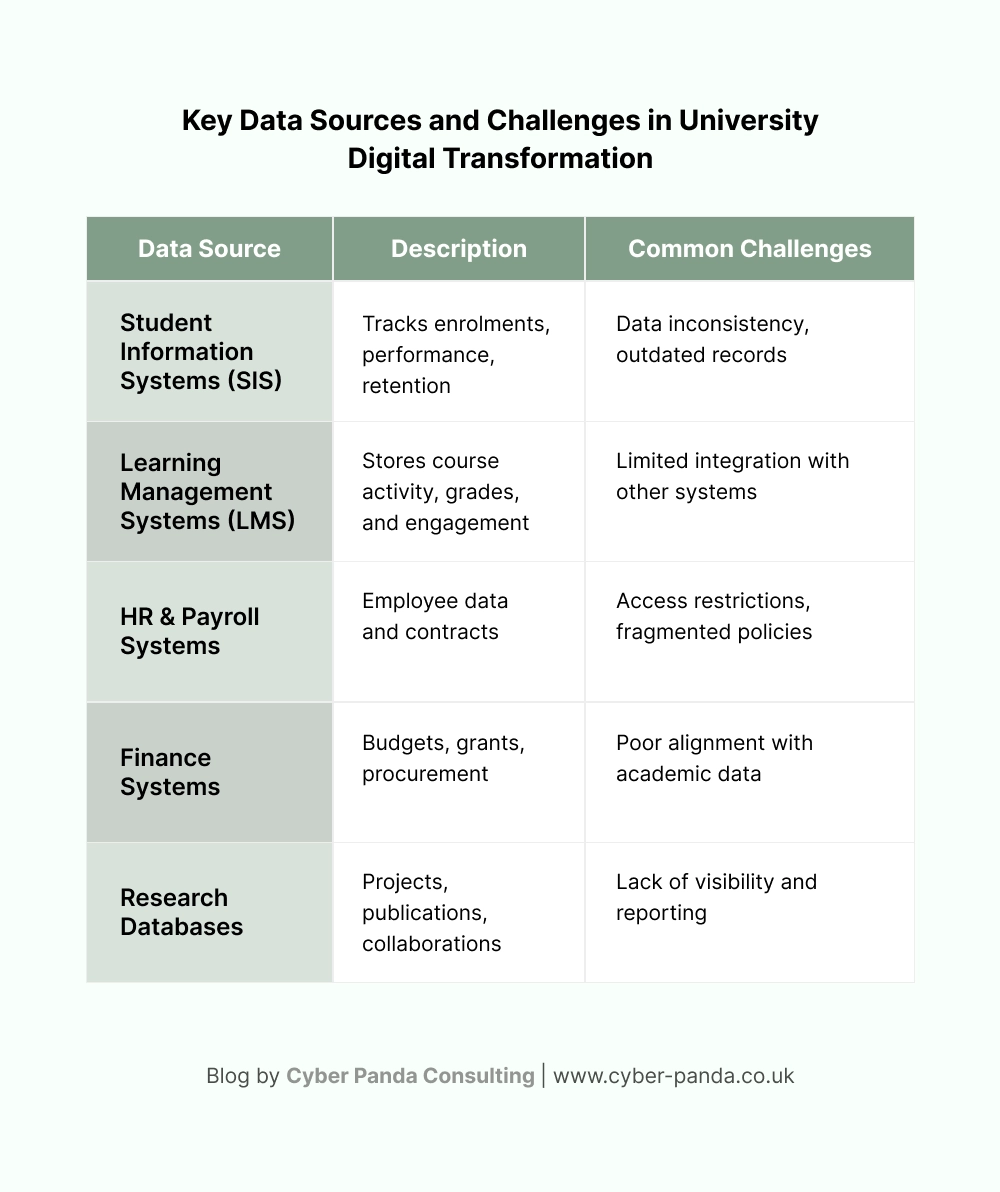
Once the data landscape is mapped, the next step is to define data ownership and accountability. Every dataset should have a designated owner, clear update cycles, and defined access rules. This forms the backbone of a trustworthy analytics environment.
Where AI Adds Real Value
AI in higher education is not about replacing human judgment, it’s about enhancing it. Universities can use machine learning and predictive models to uncover insights that would otherwise remain hidden.
Once the foundation is in place, AI begins to unlock real institutional value. Here are a few examples already reshaping UK universities:

AI, when combined with high-quality data, empowers universities to move beyond intuition, supporting evidence-based decisions that directly improve performance and student experience.
Responsible AI : Ethics, Privacy & Governance
As AI adoption accelerates, universities must navigate critical ethical questions:
Who owns the data? How transparent should algorithms be? How do we avoid bias in decision-making?
The Office for Students (OfS) in the UK has emphasised the importance of fairness and accountability in AI use across higher education. Responsible data practices mean ensuring that every AI-driven insight respects privacy, protects equality, and upholds institutional integrity.
At Cyber Panda, we believe that governance and ethics are not afterthoughts, they are the starting point of any successful AI and analytics initiative.
Building a Culture of Data Confidence
While technology and analytics platforms are key, true transformation depends on people. Universities need to build data confidence among staff and students — ensuring they understand not just how to use data, but why it matters. Encouraging data literacy, transparency, and cross-department collaboration helps create a culture where insights are trusted and acted upon, not feared or ignored.
Steps for Universities to Get Started
- Audit your data maturity
Assess where your institution stands in terms of quality, accessibility, and integration. - Create a central data strategy
Define ownership, data usage policies, and desired outcomes. - Build cross-functional teams
Bring IT, academic, and administrative staff together to align data initiatives with institutional goals. - Pilot AI projects
Start small – student retention, resource planning, or workload forecasting. Use measurable outcomes. - Review and iterate
AI success is a process. Continuous evaluation ensures transparency, scalability, and long-term impact.
How Cyber Panda Consultation Supports Universities
From digital transformation roadmaps to change management and compliance, Cyber Panda Consultation partners with universities across the UK to harness data responsibly and effectively.
We provide:
- Data strategy and integration planning
- Governance and ethics frameworks
- AI-readiness assessments
- Change management support for academic and administrative transformation
Our approach is pragmatic, built around your institutional priorities, culture, and people.
The Future Is Data-Informed, Not Data-Overwhelmed
The most successful universities will not be those with the most data, but those that use it best. AI and analytics are powerful enablers, but only when guided by clarity, ethics, and human insight.
At Cyber Panda Consultation, we help institutions move from data collection to data confidence; enabling higher education leaders to make better, faster, and more informed decisions that shape the future of learning.
Ready to see how AI and analytics can transform your university’s decision-making?
Book a free consultation today with our team at Cyber Panda and start building your data-informed future today.
Frequently Asked Questions
Start with small-scale projects focused on clear, measurable outcomes such as predictive analytics for student retention or automating manual reporting tasks. Cloud-based tools and open-source AI models make entry-level adoption affordable.
Beyond technical data skills, success depends on change management, cross-department collaboration, and leadership buy-in. Training academic and administrative staff in data literacy is often the first step.
AI tools provide real-time insights into performance, finance, and student engagement. They help leadership teams identify risks early and make evidence-based decisions that align with long-term institutional goals.
Key risks include data privacy breaches, algorithmic bias, and lack of transparency in decision-making. Ethical governance and compliance with UK data regulations (GDPR) are essential safeguards.
AI can personalise learning, predict academic challenges, recommend support services, and enhance communication ensuring students receive the right help at the right time.