
If you’ve ever tried to update a single module and found yourself chasing five departments for sign-off, you already know how broken curriculum management systems can be.
In most universities, curriculum management is more complex than it needs to be. Program approvals, module updates, and course information often live across countless spreadsheets, documents, and emails each owned by a different team. As universities grow, this patchwork becomes harder to maintain and even harder to trust.
That’s where Curriculum Management Systems (CMS) come in – not just as tools, but as frameworks to simplify, standardise, and future-proof how institutions handle academic information.
Why Curriculum Management Systems Need a Rethink
Curriculum information sits at the heart of every university operation from student recruitment and timetabling to compliance and quality assurance. Yet many institutions still manage it manually.
This approach may have worked in the past, but it’s now holding teams back. When changes to a single module can take weeks to cascade through systems, it affects everything – marketing accuracy, student experience, and even audit readiness.
A modern CMS changes that. It centralises all program and module data in one place, ensuring every department from registry to marketing works with the same, validated information.
For guidance on maintaining consistent and compliant course data, visit Advance HE’s Academic Frameworks and Quality Assurance page.
What a Good Curriculum Management System Really Does
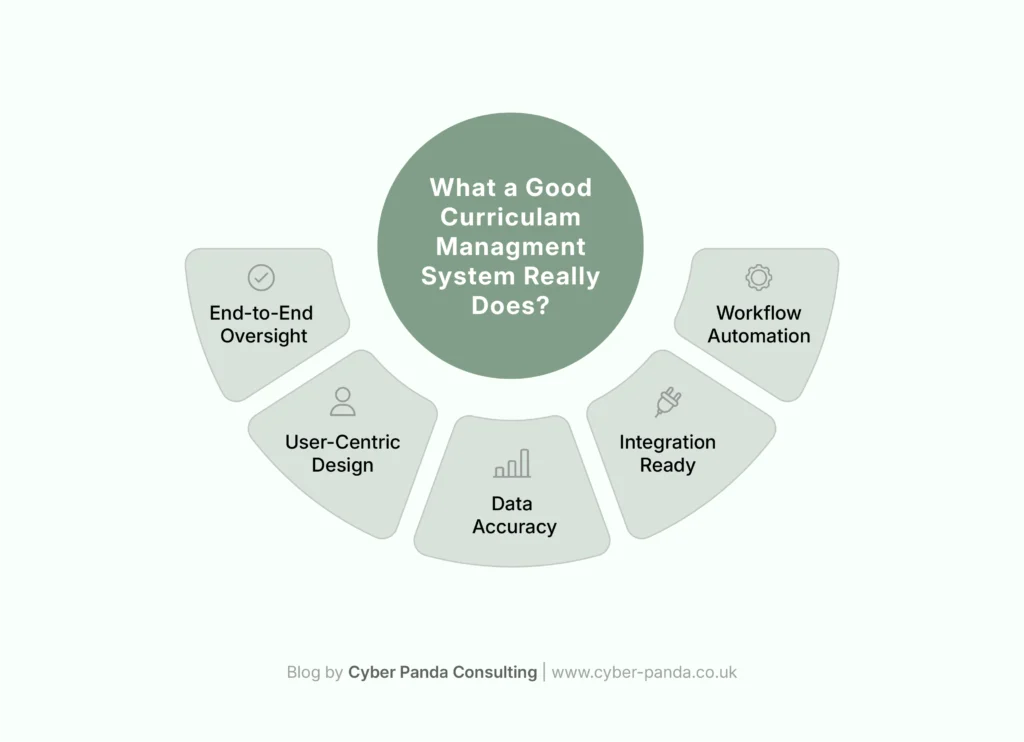
The best curriculum management system (CMS) platforms go beyond data storage. They provide structure, governance, and visibility.
Here’s what that looks like in practice:
- End-to-End Oversight: From proposal to publication, every stage is logged, version-controlled, and auditable.
- Workflow Automation: Approval routes are built in, reducing administrative delays and email trails.
- Integration Ready: A strong CMS connects seamlessly with SITS, CRMs, timetabling, and learning platforms.
- Data Accuracy: No more duplicated course data or inconsistent module codes.
- User-Centric Design: Academic staff can focus on content, not compliance forms.
By aligning processes and systems, universities can reclaim hundreds of hours each year, time better spent improving student outcomes.
Implementation Challenges of Curriculum Management Systems
However, introducing a curriculum management system isn’t a simple IT project. It’s a business change exercise that touches almost every part of the university.
Common pitfalls include:
- Misaligned expectations between academic and technical teams
- Underestimating data migration and cleansing needs
- Limited communication with end users
- Lack of clear ownership post-launch
This is why implementation success depends as much on process mapping and stakeholder engagement as it does on technical configuration.
If you’re interested in how other universities are tackling this, Jisc’s work on curriculum management in UK higher education is a useful reference.
Building the Right Foundation
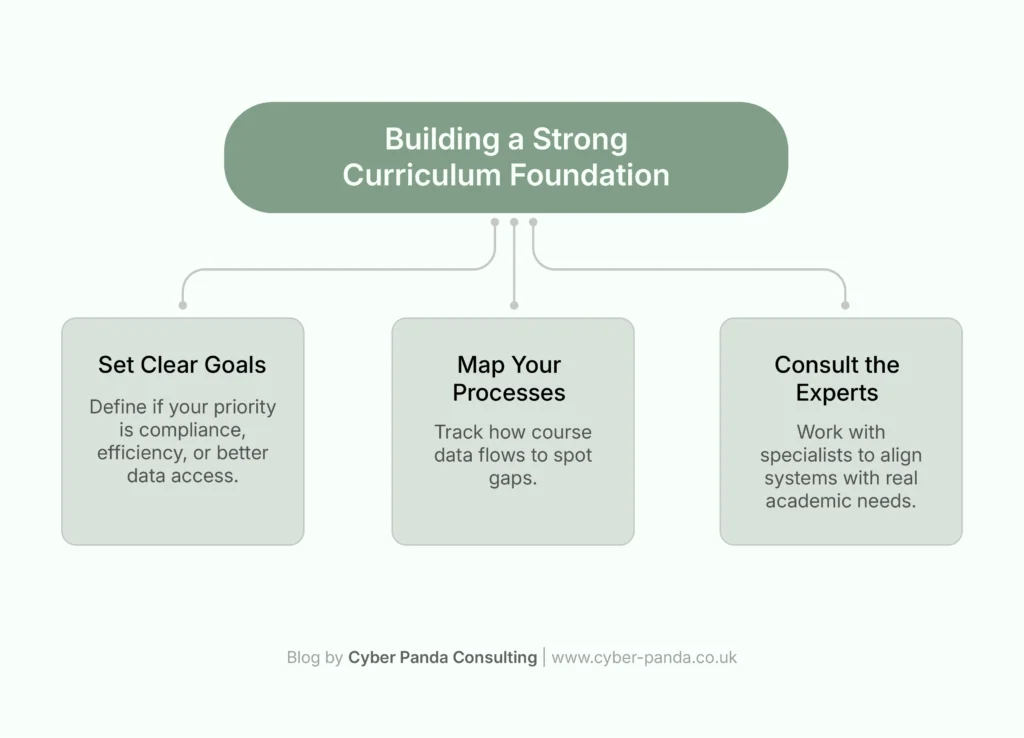
Before choosing a platform, universities should first clarify their goals. Are they looking to improve compliance, streamline internal approvals, or make academic data more accessible across systems?
Once the objectives are defined, the next step is process discovery. Understanding how course information currently flows – who creates it, who approves it, and where it breaks down gives clarity on what the new system must solve.
That’s where consulting support becomes invaluable. Experienced partners can bridge the gap between university culture and system logic, ensuring the final solution reflects real academic workflows.
The Payoff: A Smarter Academic Ecosystem
When implemented well, a Curriculum Management System becomes the foundation for digital transformation in higher education.
Benefits include:
- Faster Programme Approvals: With clear workflows and automation.
- Improved Data Governance: One version of the truth across systems.
- Reduced Manual Admin: Staff focus shifts from maintaining data to improving courses.
- Better Student Experience: Accurate course information, every time.
And most importantly, it enables institutions to adapt faster, ensuring curriculum changes keep pace with student and market needs.
Looking Ahead
With digital transformation accelerating across UK higher education, curriculum management is no longer a back-office task. It’s a strategic function.
The universities that succeed will be those that combine the right systems with the right processes, building transparency, consistency, and agility into the core of their operations.
When Expertise Makes the Difference
At Cyber Panda Consulting, we help universities implement Curriculum Management Systems the right way – aligning workflows, data structures, and user needs before a single line of configuration begins.
Whether rolling out a vendor solution or developing an in-house build, we ensure every step, from discovery to delivery supports long-term success.
If you’d like to discuss your project, Book a free consultation today or learn more About Cyber Panda.
Frequently Asked Questions
Rolling out a CMS typically takes 9 to 18 months for most UK universities. The timeline depends on factors such as data readiness, internal decision-making, and governance structures.
The goal isn’t just fast implementation, it’s ensuring people, processes, and systems are aligned from the start to guarantee long-term success.
It depends on your university’s resources and flexibility needs. Vendor solutions (like Cyber Panda Consultation) provide tried-and-tested workflows and reliable support – ideal for faster rollouts. In-house builds offer more customisation but require strong technical capacity and ongoing maintenance.
A discovery and planning phase helps determine the right approach for your institution’s goals.
Technology alone doesn’t ensure success – people do. Change management helps academic and administrative staff understand why processes are changing and how the new system benefits them.
Cyber Panda Consulting, we embed change management throughout the project from early communication and workshops to post-launch support ensuring your CMS isn’t just live, but actively adopted.